
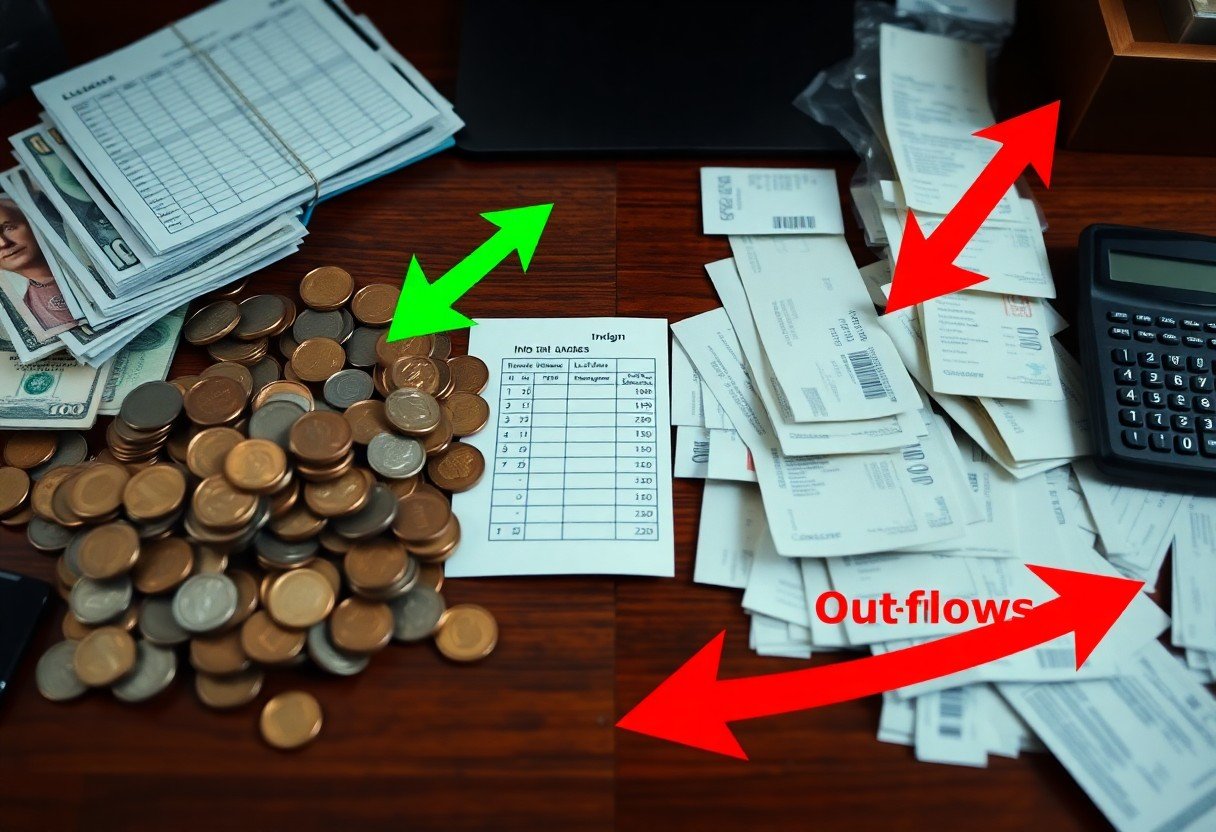
You must distinguish cash inflows-money entering your business from sales, investments, or financing-from cash outflows-payments for expenses, purchases, and debt service-so you can monitor liquidity, plan investments, and prevent shortfalls; understanding timing and predictability of each helps you make informed operational and strategic decisions.
Key Takeaways:
- Cash inflows are money received by a business or individual (sales receipts, loan proceeds, investment income); cash outflows are money paid out (operating expenses, wages, loan repayments, capital purchases).
- Net cash flow equals total inflows minus total outflows; positive net cash flow increases liquidity, negative net cash flow reduces it.
- Timing matters: when cash is received or paid affects short-term liquidity even if a business is profitable on paper.
- Profit ≠ cash: accrual accounting can show profit while receivables or inventory tie up cash, creating a cash shortfall.
- Active cash-flow management-forecasting, accelerating inflows, and controlling outflows-supports solvency and informs financing and investment decisions.
Understanding Cash Inflows
When managing your business, inflows determine how quickly you can cover expenses and invest; for example, a retailer with $200,000 in monthly sales but 45-day receivables needs faster collections to avoid a $100,000 shortfall. You should monitor timing, frequency, and variability of receipts so cash forecasts reflect real availability and you can decide between using $10,000 credit lines or delaying discretionary spending.
Definition of Cash Inflows
Cash inflows are the actual cash that enters your bank account from operations, financing, or investing activities-collected sales, loan proceeds, investor capital, dividends, and proceeds from asset sales. You care about receipts, not accrued revenue; a $30,000 invoice only improves your cash position once collected, which directly affects payroll, supplier payments, and short-term borrowing needs.
Types of Cash Inflows
Common types include operating receipts (customer payments), investing receipts (asset sales, dividends), and financing receipts (loans, equity injections); a SaaS business, for instance, might collect $120,000 monthly subscription revenue (recurring) while receiving a $500,000 seed round (one-off). You should separate recurring from non-recurring inflows to gauge sustainable cash generation and plan capital allocations.
- Sales receipts (point-of-sale or online payments)
- Accounts receivable collections (invoiced customers paying down balances)
- Loan proceeds (bank or alternative finance draws)
- Equity investment (seed, venture, or private placement)
- Any other sources such as grants, tax refunds, or insurance recoveries
| Sales receipts | $120,000 monthly subscriptions collected at point of sale |
| Accounts receivable | $50,000 invoiced customers paid within 30 days |
| Loan proceeds | $100,000 term loan disbursed to support inventory |
| Equity investment | $500,000 seed funding from angel investors |
| Asset sales/dividends | $20,000 equipment sale or $5,000 annual dividend |
Additionally, you should quantify predictability: classify inflows as recurring (monthly sales, $X) versus one-off (asset sale $Y), track days-to-cash for receivables (e.g., DSO = 45 days), and model scenarios where a 10% drop in sales impacts cash by $Z; this lets you set minimum cash buffers and decide when to draw a $25,000 line of credit.
- Recurring operating cash (subscriptions, repeat customers)
- Short-term financing inflows (bridge loans, overdrafts)
- One-off investing inflows (asset disposals, dividends)
- Intermittent receipts (grants, tax rebates)
- Any seasonal or irregular inflows like festival sales spikes or settlement proceeds
Understanding Cash Outflows
When you monitor cash outflows you focus on actual disbursements-supplier payments, payroll, rent, taxes, loan repayments and capital purchases-and their timing relative to receipts; use a rolling 13-week forecast and weekly bank reconciliations to spot shortfalls and timing mismatches, and consult Cash Inflow vs Cash Outflow Whats the Difference? for framework examples.
Definition of Cash Outflows
Cash outflows are the cash you pay out to run, invest in and finance your business: operating expenses, payroll, supplier invoices, tax settlements, capex and debt repayments. You record them on the cash flow statement under operating, investing and financing activities because each category affects liquidity and planning differently.
Types of Cash Outflows
You can split outflows into operating (COGS, wages, rent), investing (equipment, software, acquisitions) and financing (loan principal, interest, dividends); for example, a retail chain with monthly rent of $120k and quarterly capex of $300k needs a different cash buffer than a SaaS firm with predictable subscription receipts.
In practice you track frequency, predictability and size: operating outflows are usually regular and make up 50-80% of monthly cash needs, investing is lumpy and can spike in growth phases, and financing is driven by repayment schedules and dividend policy.
- Operating: supplier payments, payroll, utilities – often the largest ongoing drain on working capital.
- Investing: machinery, IT upgrades, property purchases – typically irregular but high value.
- Financing: loan principal and interest, lease obligations, dividend payouts – tied to contracts and policies.
- One-off items: tax settlements, legal payments or asset impairments that can distort monthly cash flows.
- The timing of these categories determines liquidity needs and the size of your working capital buffer.
| Operating outflows | Payroll, COGS, rent – recurring; often 50-80% of monthly cash use |
| Investing outflows | Capex, acquisitions – lumpy; e.g., $300k factory upgrade in Q2 |
| Financing outflows | Loan repayments, interest, dividends – fixed schedules affecting cash runway |
| Tax and compliance | Quarterly/annual tax payments – plan with accruals to avoid surprises |
| One-off contingencies | Legal settlements, severance – model scenarios to test liquidity impact |
Key Differences Between Cash Inflows and Outflows
Inflows are receipts like $ sales, loan proceeds, or investment returns; outflows are payments for COGS, payroll, rent, interest and loan repayments. Net cash flow equals inflows minus outflows on the cash flow statement. For instance, if your business records $200,000 in monthly inflows and $180,000 in outflows, you preserve $20,000 for reinvestment, reserves or debt service; predictability and controllability vary by source.
Impact on Financial Health
Your liquidity and solvency hinge on consistent positive net cash flow: operating cash flow margin (operating cash / sales) of 8-12% is healthy for many sectors. Persistent negative monthly cash flows-say, three straight months-often forces you to draw on credit lines or issue short-term debt, increasing interest expense and weakening ratios like current and quick.
Timing Considerations
Timing mismatches create working capital gaps: if you pay suppliers in 30 days but customers pay in 60, you fund a 30‑day shortfall. You can bridge that with a $50k line of credit, invoice factoring, or by negotiating extended payables; seasonal businesses often need 3-6 months of buffer to cover peak inventory purchases.
Digging deeper, monitor your cash conversion cycle (CCC = DIO + DSO − DPO). If your DIO is 40 days, DSO 50 days and DPO 30 days, CCC is 60 days, meaning you must finance two months of operating activity. Reducing DSO by 10 days on $3,650,000 annual sales frees about $100,000 ((3,650,000/365)×10), a measurable impact you can target through incentives for faster payments or tighter credit terms.
Importance of Cash Flow Management
Effective cash flow management ensures you can meet short-term obligations and seize growth opportunities. According to a U.S. Bank study, 82% of small businesses fail due to poor cash flow; keeping 2-3 months of operating expenses as runway and running weekly forecasts reduces that risk. You’ll avoid missed payroll, late supplier payments, and be able to fund a $10,000 marketing push or cover a 30-90 day sales cycle.
Benefits of Tracking Cash Flow
Tracking cash flow helps you spot trends, control working capital, and improve profitability: by reducing days sales outstanding (DSO) you free up cash for investment. You can negotiate 30-60 day supplier terms, smooth seasonal shortfalls, and lower reliance on expensive short-term credit. Many firms cut financing costs and increase margins simply by maintaining accurate weekly cash snapshots.
Tools for Cash Flow Management
Cloud accounting platforms like QuickBooks and Xero help you automate bank feeds and reconcile transactions, while forecasting tools such as Float or Pulse produce 12‑week rolling forecasts and scenario analyses. Payment platforms automate invoicing and reminders to accelerate collections, and even a well-structured Excel model with live CSV imports can flag timing gaps before they become emergencies.
For example, if you run a services firm you can link QuickBooks to Float to create weekly projections; this revealed a $20,000 gap before peak season, letting you delay non-crucial hires and negotiate a 30-day supplier extension. You should implement alerts for negative week-ahead balances, run best/worst-case scenarios, and update forecasts after every large invoice or payment.
Common Misconceptions about Cash Flows
Many assume cash flow equals profit, but you can be profitable and cash-poor: for example, $300,000 in revenue with $120,000 tied in receivables leaves only $180,000 in actual inflows. Similarly, paying suppliers on 60‑day terms can mask immediate cash shortages even when income statements look healthy. You should track timing mismatches-collections, payment terms, and capital expenditures-to avoid surprises and plan short‑term financing or working capital moves.
Inflows vs. Income
You often book income when a sale is made, yet cash inflow may lag: invoice $50,000 in March and collect $20,000 in April, $30,000 in May. Under accrual accounting your income statement shows $50,000, but your cash statement shows only $20,000 for March collections. Also consider loan proceeds or asset sales-these are inflows that don’t count as operating income but affect your cash position immediately.
Outflows vs. Expenses
Paying $10,000 to a supplier reduces your cash but may not hit the income statement if that payment clears a prior inventory purchase; conversely, a $12,000 depreciation expense lowers profit without any cash movement. Loan principal repayments (e.g., $5,000 monthly) are cash outflows classified as financing, not expenses, while interest is an expense and a cash outflow.
On the cash flow statement you must separate operating, investing, and financing outflows: buying equipment for $25,000 shows as investing cash outflow, then depreciation spreads its expense over years-impacting profit but not the initial cash. Tax timing also matters: paying a deductible expense this year can reduce taxable income now, yet if you accrued it previously the cash impact differs from the tax deduction timing.
Summing up
So you should track cash inflows-the money entering your business from sales, investments, or financing-and outflows-the payments you make for expenses, wages, and purchases-so you can gauge liquidity, plan budgets, and make informed decisions; managing the timing and amount of each helps you avoid shortfalls and seize growth.
FAQ
Q: What are cash inflows and cash outflows?
A: Cash inflows are funds entering a business or personal account, such as cash sales, collections from customers, loan proceeds, investment income, and asset sales. Cash outflows are funds leaving an account, including payments for operating expenses, wages, supplier invoices, loan repayments, tax payments, capital expenditures, and dividends. Inflows increase available cash; outflows decrease it.
Q: How do inflows and outflows differ from revenue and expenses?
A: Revenue and expenses are accounting measures recorded on an accrual basis when earned or incurred, while cash inflows and outflows track actual cash movements. For example, a sale on credit increases revenue immediately but generates a cash inflow only when the customer pays. Conversely, an expense recorded under accrual accounting may not require an immediate cash outflow.
Q: How are cash inflows and outflows presented in financial statements?
A: They appear on the cash flow statement, divided into three sections: operating activities (cash from core business operations), investing activities (cash used for or from buying/selling long-term assets), and financing activities (cash from borrowing, equity issuance, or repayments/dividends). The statement reconciles beginning and ending cash balances and shows net cash increase or decrease for the period.
Q: What risks arise when inflows and outflows are mismatched, and what causes that mismatch?
A: Mismatches create liquidity risk: even profitable entities can face cash shortages if outflows occur before inflows. Common causes include delayed customer payments, seasonal sales fluctuations, large unexpected capital expenditures, poor inventory management, overly generous credit terms, and mis-timed tax or loan payments. Persistent mismatches can force borrowing or asset sales.
Q: What practical steps can improve net cash inflows and manage outflows?
A: Improve inflows by invoicing promptly, offering early-payment discounts, tightening credit controls, and diversifying revenue sources. Control outflows by negotiating supplier terms, prioritizing payments, deferring nonimperative capital spending, leasing instead of buying where appropriate, and maintaining an emergency credit line. Regular cash flow forecasting, scenario planning, and monitoring working capital metrics help anticipate and smooth timing gaps.