
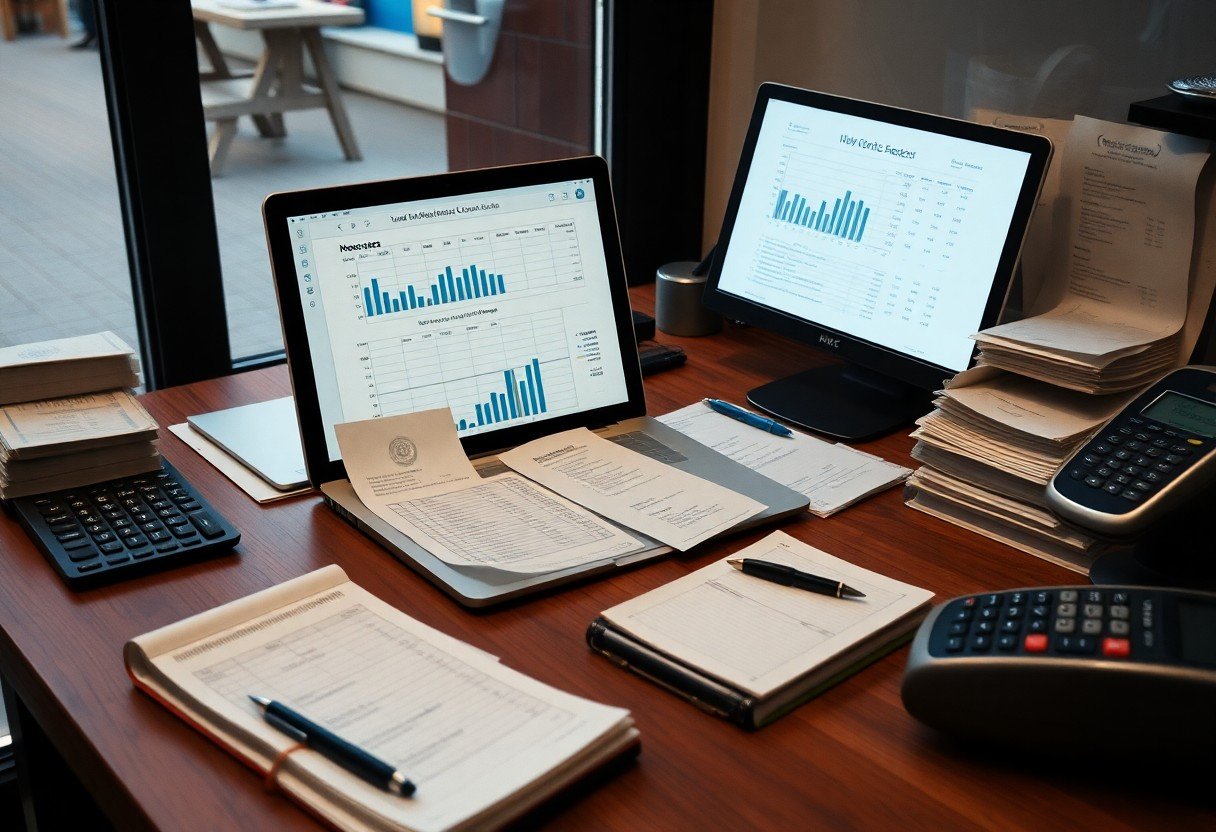
With a clear grasp of cash flow, budgeting, basic accounting, and tax obligations, you can steer your small business toward stability and growth. You should track income and expenses, maintain separate business accounts, prepare regular financial statements, manage receivables and payables, set emergency reserves, and plan for taxes and compliance. Understanding unit economics, pricing, and key metrics lets you make informed decisions and communicate confidently with lenders and advisors.
Key Takeaways:
- Manage cash flow proactively: track inflows and outflows, maintain a cash buffer, and forecast short-term needs.
- Create a realistic budget and update forecasts regularly to guide spending and set financial targets.
- Keep accurate bookkeeping and use accounting tools or a professional to reconcile accounts and produce financial reports.
- Know tax obligations and compliance deadlines, set aside funds for taxes, and keep organized records for deductions.
- Monitor credit and financing options: build business credit, compare loan terms, and choose funding that matches growth plans.
Understanding Financial Statements
You use three primary reports to gauge performance: the balance sheet (a point-in-time snapshot), the income statement (profitability over a period), and the cash flow statement (actual cash movement). For example, a current assets total of $120,000 versus current liabilities of $80,000 gives a current ratio of 1.5, signaling short-term coverage; that single metric often guides whether you tighten credit terms, delay purchases, or seek short-term financing.
Balance Sheet
On the balance sheet you see assets, liabilities, and owner equity where assets = liabilities + equity. Current assets like cash ($25,000), receivables ($20,000), and inventory ($50,000) fund operations, while long-term assets cover growth. You monitor liquidity with the current ratio (aiming for 1.5-2.0) and solvency with debt-to-equity; if assets are $95,000 and debt $60,000, equity is $35,000 and debt-to-equity is about 1.7, guiding capital decisions.
Income Statement
The income statement breaks revenue down by costs and expenses to show profit: revenue minus COGS equals gross profit, then subtract operating expenses to reach net income. For instance, $200,000 revenue with $120,000 COGS leaves $80,000 gross profit (40% gross margin); after $50,000 operating expenses, operating income is $30,000, a 15% net margin that helps you price products and set overhead targets.
You should also track subtotals like EBITDA and operating income, separate one-time gains or interest expense, and compare month-over-month and year-over-year trends. Use break-even math-if fixed costs are $30,000 and contribution margin is 40%, break-even revenue is $75,000-to test pricing or marketing scenarios before committing to hires or capital expenditures.
Cash Flow Statement
The cash flow statement reconciles net income to cash by section: operating (collections, payables), investing (capex, asset sales), and financing (loan proceeds, owner draws). A common trap is profitable months with negative cash: if net income is $30,000 but accounts receivable rise $15,000, operating cash falls to $15,000; add $10,000 capex and net cash change is only $5,000, which affects payroll and suppliers.
Focus on free cash flow (operating cash minus capex) for sustainable growth and the operating cash flow ratio (operating cash ÷ current liabilities). Runway examples help decisions: if your monthly burn is $8,000 and cash on hand is $24,000, you have three months to cut costs, raise revenue, or secure financing to avoid distress or covenant breaches.
Budgeting for Small Businesses
Effective budgeting forces you to translate sales forecasts into actionable cash plans: project monthly revenue, map fixed costs, and flag seasonal swings. Aim to hold 3-6 months of operating expenses as a reserve and monitor variances weekly; many small retailers keep COGS around 25-40% while payroll often runs 20-35%. Use scenario planning and consult resources like 10 concepts every small business owner needs to understand to sharpen assumptions.
Importance of Budgeting
Budgeting gives you a control map: it predicts cash shortages, guides hiring, and times inventory purchases for peak seasons. For example, a cafe that sees a 40% drop in winter can plan temporary staffing cuts and a targeted promotion rather than emergency borrowing. Track cash flow weekly and compare actuals to budget monthly to keep variances under 10% and preserve your runway.
Creating a Budget
Start by listing fixed costs (rent, insurance) and variable costs (supplies, commissions), then forecast conservative sales for 12 months. Build three scenarios-best, expected, worst-and set KPI thresholds (gross margin, net margin, burn rate). For example, on $20,000 monthly revenue, allocate $6,000 to fixed costs, $5,000 to payroll, and keep a $3,000 monthly buffer while investing remaining funds in growth.
Implement the budget with a weekly cash-flow spreadsheet or cloud accounting: record receipts, categorize expenses, and reconcile bank accounts every week. Adjust assumptions monthly-if sales fall 10% versus forecast, cut discretionary spend by the same percentage and test a 5% price-increase pilot. Use a rolling 12-month forecast and aim to keep monthly variance between forecast and actual under 5-10% so the budget stays actionable.
Managing Cash Flow
Managing cash flow demands constant attention: keep a 90-day rolling forecast, maintain a 10% operating cash buffer, and reconcile bank activity weekly to spot shortfalls. You should align payroll and major vendor payments with projected receipts, tag seasonal peaks in your forecast, and set alerts for when balances approach your minimum cushion to avoid costly short-term loans.
Cash Flow Basics
Inflows are sales, receivables and financing; outflows are payroll, rent, inventory and debt service. Monitor days sales outstanding (DSO), cash burn rate and the cash conversion cycle-if your DSO is 45 days and payables are 30 days, you face a 15-day funding gap. Use weekly aging reports and bank reconciliations to spot trends early.
Strategies for Improving Cash Flow
You can tighten payment terms from net‑60 to net‑30, offer a 2%/10 discount to accelerate receipts, and send electronic invoices immediately to cut DSO. Also reduce inventory carrying costs by increasing turnover, negotiate extended payables (e.g., 30→45 days), and keep a small line of credit or a $10k-$50k overdraft for seasonal gaps.
For example, a B2B printer cut DSO from 60 to 20 days by switching to e‑invoicing and a 1.5% early‑pay incentive, freeing about $80,000 in working capital; a retailer improved inventory turns from 6 to 9 and released $50,000 in cash. If you need liquidity fast, invoice factoring can advance 70-90% of invoice value within 48 hours.
Financing Options for Small Businesses
When you need capital, weigh options by cost, term, and speed: traditional bank or SBA loans usually give lower rates and longer amortization, while lines of credit, invoice factoring, merchant cash advances, equity, and crowdfunding trade cost for speed or flexibility. You should match the funding type to a specific need-equipment purchases favor longer-term loans, seasonal inventory calls for a revolving line or factoring, and rapid growth sometimes requires equity to avoid high short-term interest.
Traditional Loans
Banks and SBA programs are best when you have 2+ years of operating history, steady cash flow, and solid credit: SBA 7(a) can go up to $5M with terms up to 10-25 years depending on use, and banks commonly expect personal guarantees and collateral. You should plan for down payments around 10-20% and interest that typically ranges from about 6%-12% based on credit, term, and market conditions, yielding predictable monthly payments for capital expenditures or real estate.
Alternative Financing
Online lenders, invoice factoring, merchant cash advances (MCAs), and crowdfunding deliver speed and looser underwriting at higher cost: you can see funding in days, often without long operating histories, but rates and fees vary widely. You should use these for short-term working capital, bridging receivables, or fast inventory buys, while tracking total cost of capital and repayment structure to avoid cash-flow stress.
For example, invoice factoring fees typically run about 1%-5% of invoice value per 30-90 days, online term loans often carry APRs from roughly 10%-40%, and MCAs can produce effective APRs from 20% into triple digits depending on holdback and payback speed. You should model total repayment amounts: a $50,000 factoring arrangement at a 3% fee per 30 days frees immediate cash but costs $1,500 per 30 days on invoices you would otherwise collect, so compare against slower, cheaper bank options.
Tax Considerations
Plan for taxes as an ongoing cash-flow item: estimate quarterly payments, set aside payroll and sales tax proceeds, and factor likely liabilities into monthly forecasts so year-end surprises don’t derail operations.
Tax Obligations for Small Businesses
If you’re self-employed you owe self-employment tax (~15.3%) plus income tax and should pay estimated taxes quarterly (typically due in April, June, September and January). If you have employees you’ll withhold income tax and remit payroll taxes (employer share ~7.65%). Also monitor sales tax nexus rules-many states trigger collection when you exceed $100,000 in sales or 200 transactions-so register where you meet thresholds.
Deductions and Credits
You can lower taxable income with common deductions: the home-office simplified method pays $5 per usable square foot (cap 300 sq ft), business meals are generally 50% deductible, and Section 179 lets you expense qualifying equipment immediately (limits have been in the six-figure to low seven-figure range in recent years). Keep receipts, allocate mixed-use expenses, and track depreciation schedules.
For example, if you use 240 sq ft for a home office at $5/sq ft you reduce taxable income by $1,200; a retail owner who expensed $20,000 of POS hardware under Section 179 saw that entire $20,000 lower taxable income in year one. Maintain contemporaneous logs for mileage, receipts for meals, and invoices for equipment to substantiate claims during audits.
Record Keeping Essentials
Importance of Accurate Records
Accurate records let you track cash flow, prepare precise tax returns and support loan or grant applications; tax authorities generally expect you to retain documents for about 3-7 years. When you reconcile bank statements weekly, you spot errors and fraud early-one café owner cut supplier overcharges by $2,400 a year after tightening records-so clean books directly improve profitability and decision-making.
Tools and Software for Record Keeping
You can automate most tasks with tools like QuickBooks Online, Xero, FreshBooks or free options like Wave; add Dext/Hubdoc or Expensify for receipt capture and use Square or Shopify integrations for POS sales. Features to prioritize are bank feeds, mobile receipt upload, automatic categorization, audit trails and CSV exports for your accountant.
Choose by transaction volume and features: if you process under ~100 transactions/month, FreshBooks or Wave may suffice; above ~500, QuickBooks or Xero handle scale and inventory better. Set reconciliation cadence (weekly preferred, monthly minimum), enable cloud backups, and grant accountant access so tax prep and forecasting use the same clean dataset.
To wrap up
Hence you should master cash flow forecasting, budgeting, bookkeeping, and basic financial statements to track performance; set prices to maintain healthy margins; manage taxes and credit responsibly; maintain an emergency fund; and monitor key metrics like gross margin, net profit, and cash runway to guide decisions and grow sustainably.
FAQ
Q: What financial statements should every small business owner understand?
A: The three core statements are the income statement (profit & loss), balance sheet, and cash flow statement. The income statement shows revenue, cost of goods sold, gross profit, operating expenses, and net profit over a period. The balance sheet lists assets, liabilities, and owner’s equity at a point in time and helps assess solvency. The cash flow statement reconciles net income to cash movements from operations, investing, and financing and highlights timing gaps between profits and available cash. Review these monthly and use them to spot trends, confirm profitability, and support planning or lending applications.
Q: How should I manage cash flow to avoid shortfalls?
A: Build a rolling cash flow forecast that projects receipts and disbursements for at least 90 days, updating it weekly. Speed up inflows by invoicing promptly, using clear payment terms, offering incentives for early payment, and following up on late accounts. Stretch out outflows by negotiating vendor terms, scheduling payments, and prioritizing payroll and critical suppliers. Maintain a cash buffer or a line of credit for unexpected timing gaps, control inventory levels, and monitor accounts receivable aging to prevent surprises.
Q: How do I set prices so the business remains profitable?
A: Start by calculating all direct costs (COGS) and allocating a share of fixed and variable operating expenses to each product or service. Use cost-plus pricing to ensure a target gross margin, or value-based pricing when the market supports it. Compute break-even volume: fixed costs ÷ contribution margin per unit. Track gross margin and net margin by product or customer, adjust pricing for cost changes or market shifts, and factor in desired return on investment and competitive positioning.
Q: What bookkeeping and accounting practices should I implement from day one?
A: Separate personal and business accounts and use business banking and credit cards for all transactions. Choose a consistent accounting method (cash or accrual) and adopt accounting software to maintain a clear chart of accounts. Reconcile bank and credit card statements monthly, retain receipts and digital copies, and categorize expenses promptly. Establish internal controls for cash handling, perform regular financial reviews, and engage a bookkeeper or accountant for payroll, tax filings, and periodic financial analysis.
Q: How should I plan for taxes and secure financing when needed?
A: For taxes, estimate your effective tax rate and set aside funds regularly (for example, in a separate account) to cover income and payroll taxes; make quarterly estimated payments if required. Keep detailed records of deductible expenses, classify payroll correctly, and consult a tax professional for credits and entity-structure optimization. For financing, prepare up-to-date financial statements, a clear business plan, and cash flow projections; compare options such as term loans, lines of credit, SBA loans, merchant cash advances, or investor capital by cost and flexibility. Maintain good credit, track debt service coverage, and choose financing that matches the timing and purpose of cash needs.