
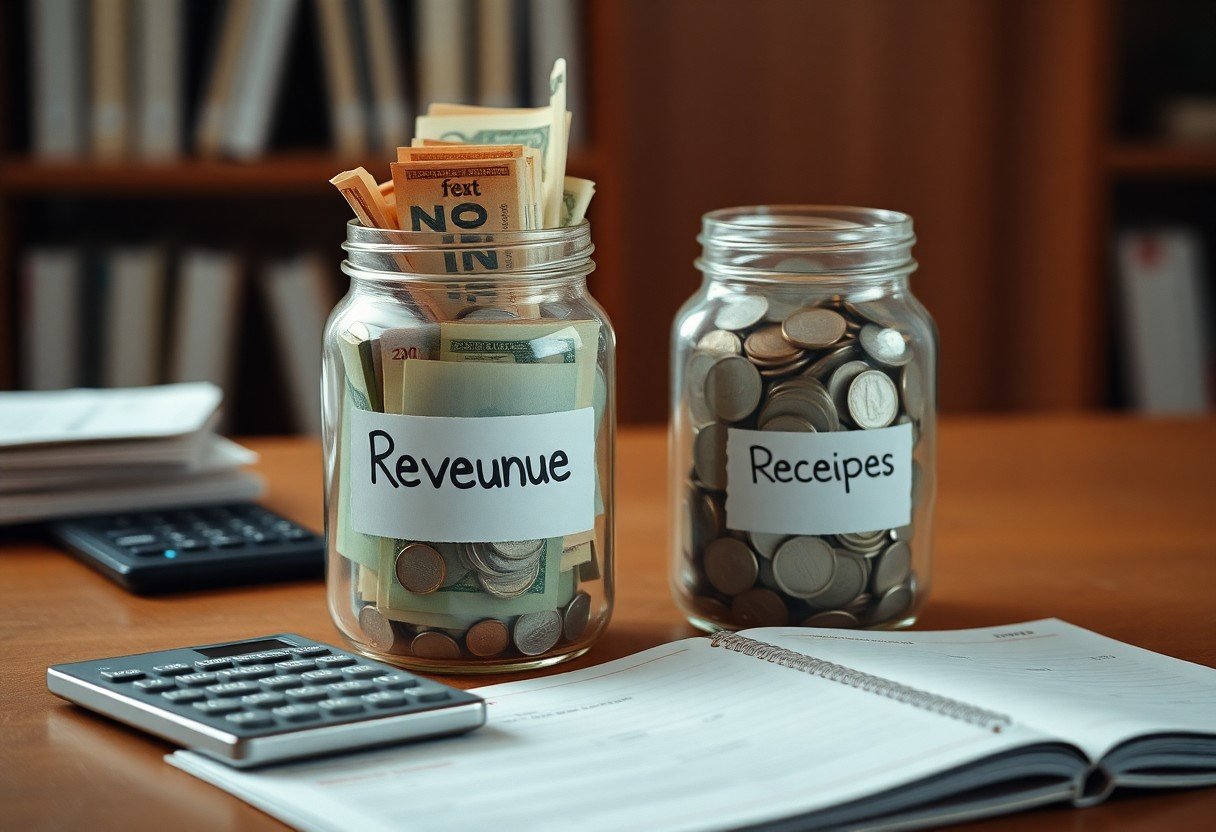
Many business owners and managers confuse revenue with profit, but you need to know the difference: revenue is all income generated from sales, while profit is what remains after you subtract costs, taxes and expenses; understanding this lets you assess margins, pricing and the long-term viability of your business.
Key Takeaways:
- Revenue is the total money a company brings in from sales or services – the “top line.”
- Profit is what remains after subtracting expenses from revenue; it measures actual financial gain.
- There are profit levels: gross profit (revenue minus direct costs), operating profit (after operating expenses), and net profit (after all expenses, taxes, interest).
- Revenue growth shows demand and scale, while profit shows efficiency, cost control, and long-term sustainability.
- A business can have high revenue but low or negative profit if costs are too high; cash flow and profit are related but not identical.
Understanding Revenue
Revenue is the total inflow from selling goods or services before any expenses are deducted; you use it to measure market demand and scale. For example, selling 10,000 units at $25 generates $250,000 in gross revenue, which feeds forecasting, investor metrics, and cash planning.
Definition of Revenue
Revenue equals the sum of money you receive from customers for products or services over a period. Gross revenue is price × quantity; net revenue subtracts returns, discounts, and allowances. If you sell 5,000 subscriptions at $12/month, your monthly gross revenue is $60,000 before churn and fees.
Types of Revenue
Revenue typically falls into categories like product sales, services, subscriptions, licensing/royalties, and interest/other income. Each behaves differently: product sales are often one-time and seasonal, subscriptions provide recurring MRR, and licensing can scale with low marginal cost.
- Product sales – one-time transactions; margins vary (retail often 20-50%).
- Services – billed hourly or by project; consultants commonly charge $100-300/hr.
- Subscriptions – recurring MRR/ARR; average revenue per user (ARPU) commonly $10-100/month.
- Licensing & royalties – per-seat or percentage-based revenue; can yield high gross margins.
- Knowing how each stream behaves helps you forecast cash flow and choose growth levers.
| Product sales | One-time revenue; example: 10,000 units × $25 = $250,000; gross margins 20-60% |
| Services | Hourly/project fees; example: consultancy billing $150/hr; utilization drives revenue |
| Subscriptions | Recurring MRR/ARR; example: ARPU $10-50/mo; churn and LTV matter most |
| Licensing & Royalties | Per-seat or % of sales; example: software $100+/user/yr or royalties 5-20% |
| Interest & Other | Passive or non-core income; example: bank interest 0.5-5% or asset sale proceeds |
You should treat each revenue type differently when forecasting: subscriptions need churn and ARPU models, product sales require seasonality and SKU-level margins, and services depend on billable hours and utilization. SaaS businesses often see gross margins of 70-90%, while traditional retail commonly runs 20-50%, which directly affects cash flow and reinvestment capacity.
- Track MRR/ARR for recurring models to measure growth velocity.
- Segment revenue by channel (online, wholesale, enterprise) to spot trends.
- Calculate blended gross margin to understand available cash for operations.
- Use cohort analysis on subscriptions to forecast LTV and churn impacts.
- Knowing your revenue mix guides valuation, forecasting, and cash management decisions.
Understanding Profit
When you look past top-line revenue, profit shows what actually stays in your business after costs; it’s the metric investors and managers use to judge viability. For example, if your store brings in $200,000 in sales but incurs $140,000 in combined cost of goods and operating expenses, your profit of $60,000 reveals whether growth is funded internally or needs outside capital.
Definition of Profit
You measure profit as revenue minus expenses, with common formulas like gross profit = revenue − COGS, operating profit = gross − operating expenses, and net profit = operating − interest/taxes. If you had $200,000 revenue, $80,000 COGS and $50,000 operating costs, gross would be $120,000, operating $70,000 and net $60,000-figures you use to compare margins across periods or competitors.
Types of Profit
You should distinguish gross, operating, and net profit (and metrics like EBITDA and contribution margin) because each answers a different question: gross shows product profitability, operating shows core business performance, and net shows overall return after financing and taxes. SaaS businesses often target gross margins above 70%, while retailers may accept 20-50% gross but focus on higher sales volume to reach healthy net margins.
- Gross profit: revenue minus cost of goods sold, used to set pricing.
- Operating profit: gross minus operating expenses, used to measure core operations.
- The net profit: final bottom-line after interest and taxes, used to assess overall returns.
| Gross Profit | Shows product-level margin; e.g., $200k revenue − $80k COGS = $120k (60% gross margin) |
| Operating Profit | Reflects core operations after OPEX; e.g., $120k gross − $50k OPEX = $70k |
| Net Profit | Final profit after interest/taxes; e.g., $70k − $10k interest/tax = $60k (30% net margin) |
| EBITDA | Excludes depreciation/amortization; useful for comparing capital-intensive firms (e.g., manufacturing) |
| Contribution Margin | Price − variable cost per unit; helps decide whether to accept special orders or scale production |
You can use these profit types to run sensitivity analyses: vary price by 5%, COGS by 10%, or reduce OPEX by 8% to see effects on net margin, and benchmark against industry medians-retail net margins often sit 2-8%, while software companies may run 10-25% net. By tracking trends monthly and comparing peers, you spot margin compression early and prioritize interventions like cost renegotiation or pricing shifts.
- Use gross margin to optimize product mixes and pricing.
- Monitor operating margin to control overhead and staffing decisions.
- The net margin guides dividend, reinvestment, or financing choices.
| Metric | How you apply it |
| Gross Margin | Assess SKU profitability and set target markups (e.g., 40-60% for apparel) |
| Operating Margin | Evaluate efficiency of sales, marketing, and admin spend |
| Net Margin | Decide on dividends, buybacks, or reinvestment given financial obligations |
| EBITDA | Compare firms with different capital structures or depreciation schedules |
Key Differences Between Profit and Revenue
Financial Implications
Revenue measures your total sales-if you sell $1,000,000 of product, that’s revenue. Profit is what’s left after costs: with a 20% gross margin you’d have $200,000 gross profit, and after $150,000 in operating expenses your net profit is $50,000 (5% margin). Revenue growth alone can hide shrinking margins or rising fixed costs that turn scale into losses.
Importance in Business Decision-Making
You use revenue to gauge market demand and profit to decide sustainability: lenders and investors often examine cash flow and net profit, while you may prioritize revenue when chasing market share. For example, a startup that grows revenue 50% year-over-year but posts negative EBITDA must show a path to profit to secure long-term financing.
In practice you balance KPIs-gross margin, operating margin, contribution margin-to set pricing, hiring, and capital allocation. Run break-even and sensitivity analyses: if your unit price rises from $100 to $105 and volume drops from 1,000 to 980, revenue moves from $100,000 to $102,900 while per-unit contribution improves, often lifting net profit. Use scenario modeling to choose whether to push top-line growth or tighten margins based on cash runway, customer lifetime value, and acquisition cost metrics.
Examples to Illustrate the Difference
Compare specific numbers to see how revenue can mask profitability: a business may pull in large sales yet show thin or negative profit once you subtract cost of goods sold, payroll, rent, interest and taxes, so you should always check both the top-line revenue and the bottom-line profit to judge performance.
Case Studies
Below are real-style examples with revenues, costs and resulting profits so you can compare margins directly across business types and spot where high revenue doesn’t automatically mean high profit.
- Independent coffee shop – Revenue $240,000; COGS $60,000; Rent & wages $140,000; Net profit $40,000 (16.7% margin).
- SaaS startup (ARR basis) – Revenue $2,000,000; CAC & marketing $200,000; Hosting & R&D $1,200,000; SG&A $300,000; Net profit $300,000 (15% margin).
- Retail chain (annual) – Revenue $10,000,000; COGS $6,000,000; Operating expenses $3,000,000; Net profit $1,000,000 (10% margin).
- Manufacturing firm – Revenue $25,000,000; Raw materials $10,000,000; Labor & overhead $8,000,000; SG&A $4,000,000; Net profit $3,000,000 (12% margin).
Real-World Scenarios
If you run a seasonal business, you can see large revenue spikes during peak months that only translate into modest profit gains because variable costs and temporary staffing rise faster than sales; your profit margin might move from 8% annual to 10% peak despite a 40% revenue surge.
Elsewhere, discounts and promotions can lift quarterly revenue by 20% while compressing margin by 30%; conversely, a one-time asset sale could add $500,000 to revenue but be excluded from operating profit, so you should separate recurring operating profit from non-operating gains when evaluating health.
Common Misconceptions
Misconceptions often arise when you equate sales with health; if you sell $100,000 but incur $120,000 in costs and interest, revenue is $100,000 while profit is −$20,000. Cash‑flow timing, one‑off expenses and taxes distort the picture. For a practical comparison, see Understanding Profit vs. Revenue: Key Differences Explained.
Myths about Revenue
You might assume rising revenue always signals strength; a company can post $500,000 in sales but lose money if returns, heavy discounts or a 70% cost of goods sold leave margins thin. Seasonal spikes or aggressive customer acquisition can inflate top‑line figures while unit economics deteriorate, so track gross margin and customer lifetime value alongside revenue.
Myths about Profit
Many think profit equals spendable cash; a $50,000 net profit can still leave you short if $40,000 is tied up in inventory and unpaid invoices. Non‑cash charges like depreciation and timing differences between receivables and payables mean profit doesn’t automatically translate to liquidity.
Dig deeper: gross profit, operating profit, EBITDA and net profit each tell a different story-40% gross margin on $200,000 revenue yields $80,000 gross profit, but $95,000 in operating expenses produces a $15,000 net loss. One‑time gains (asset sales) can temporarily boost net profit, so you should analyze recurring margins, cash‑flow statements and ratios like net profit margin (net profit ÷ revenue) to judge sustainability.
To wrap up
As a reminder, revenue is the total money your business brings in from sales, while profit is the leftover after subtracting costs, taxes, and expenses; knowing both lets you evaluate performance, set pricing, manage costs, forecast cash flow, and make informed strategic decisions to improve margins and sustain growth.
FAQ
Q: What is revenue?
A: Revenue is the total income a business earns from its normal activities, usually from selling goods or services, before any costs or expenses are subtracted. It can be calculated as unit price × units sold for products, and may include service fees, subscription payments, and sales taxes collected (usually passed through). Businesses often report gross revenue and net revenue (gross revenue minus returns, allowances, and discounts).
Q: What is profit and what are the main types?
A: Profit is the amount left after subtracting expenses from revenue. Key types are: gross profit (revenue − cost of goods sold), operating profit or EBIT (gross profit − operating expenses such as wages, rent, marketing), and net profit (operating profit ± non-operating items − interest − taxes). Example: if revenue = $100, COGS = $40, operating expenses = $30, interest/taxes = $10, then gross profit = $60, operating profit = $30, net profit = $20.
Q: How do profit and revenue provide different signals about a company’s performance?
A: Revenue shows how much business a company is doing and its market reach; it indicates scale and demand. Profit reveals efficiency, cost control, and true financial health; it shows whether the business keeps value after paying costs. High revenue with low profit can point to thin margins, high costs, or heavy investment; high profit with modest revenue suggests strong margins or efficient operations. Different stakeholders prioritize differently: sales teams and growth investors watch revenue, while lenders and owners focus on profit and cash flow.
Q: How can a company have high revenue but still report no profit or a loss?
A: That happens when total expenses equal or exceed revenue. Causes include high cost of goods sold, steep operating expenses (payroll, rent, marketing), large depreciation/amortization, heavy interest on debt, aggressive pricing or discounts, or significant returns and allowances. Example: $1,000,000 revenue with $600,000 COGS and $450,000 operating expenses results in an operating loss of $50,000 even though sales are strong.
Q: What practical steps can businesses take to improve profit without relying on increasing revenue?
A: Reduce cost of goods sold by negotiating supplier prices, improving inventory management, or sourcing cheaper materials; cut operating expenses through automation, process improvements, or resizing non-core activities; improve product mix by promoting higher-margin items; adjust pricing strategies (bundle, tiered pricing, value-based pricing); reduce waste and returns; refinance debt to lower interest; and optimize tax planning. Small margin improvements across several areas often boost net profit faster than chasing large revenue increases.