
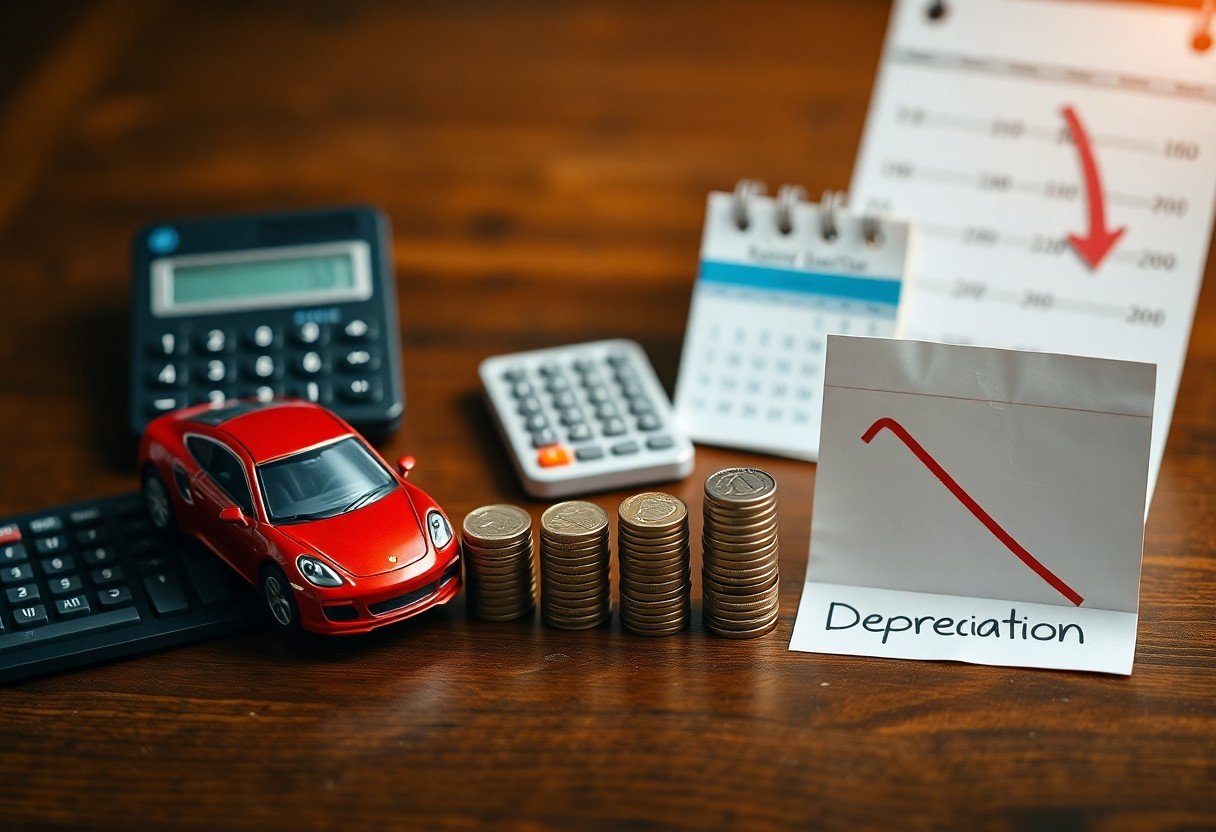
You can think of depreciation as the gradual loss in value of an asset over time, and understanding it helps you track true costs, set prices, and report accurate financial results; this guide explains basic methods, why depreciation matters for assets like equipment or vehicles, and how it affects your taxes and balance sheet in simple, practical terms.
Key Takeaways:
- Depreciation is spreading the cost of a physical asset (like equipment or a vehicle) over the years it is used.
- Common methods are straight-line (same amount each year) and declining-balance (more expense early, less later).
- It matches the asset’s expense to the revenue it helps generate and reflects the asset’s loss of value over time.
- Annual depreciation depends on purchase price, expected useful life, and any salvage (residual) value.
- On financial statements it lowers an asset’s book value and reduces reported profit while often providing tax deductions.
Understanding Depreciation
Depreciation allocates an asset’s cost across the years you use it so your financials reflect consumption of value rather than market price. For example, a $20,000 delivery van with a five-year useful life and $2,000 salvage yields straight-line depreciation of ($20,000−$2,000)/5 = $3,600 per year, which impacts both profit and tax timing.
Definition of Depreciation
Depreciation is an accounting method that spreads an asset’s purchase cost over its useful life, helping you allocate expense to the periods that benefit from the asset. It relies on estimates like useful life and salvage value; for instance, a $3,000 laptop with a three-year life and $300 salvage produces annual straight-line depreciation of ($3,000−$300)/3 = $900.
Importance of Depreciation
Depreciation lowers taxable income and aligns costs with revenue, so you get a clearer picture of ongoing profitability and cash flow needs. Practically, a $10,000 yearly depreciation charge reduces pre-tax income, which can decrease tax payments and free cash for reinvestment or replacements.
Different methods change timing and tax impact: straight-line spreads cost evenly, while accelerated methods front-load expense-e.g., a $50,000 machine over five years gives $10,000/year straight-line but roughly $20,000 in year one under double-declining-affecting your early-year tax savings; US tax reporting uses MACRS classes (3, 5, 7, 27.5, 39 years) to determine recovery periods.
Types of Depreciation
You commonly see five methods: straight-line for even expense, declining balance for accelerated write-offs, units-of-production tied to usage, sum-of-the-years-digits for front-loaded expense, and component depreciation for parts with different lives. Each method affects your profit, taxes, and cash flow differently; choose based on asset use and tax rules.
- Straight-line
- Declining balance (e.g., double-declining)
- Units of production
- Sum-of-the-years-digits (SYD)
- Component depreciation
| Straight-line | Even expense; use when asset provides consistent benefit |
| Declining balance | Accelerated; 200% DB often used for 3-7 year assets |
| Units of production | Expense follows hours, miles, or units produced |
| Sum-of-the-years-digits | Front-loads depreciation more than straight-line but less than DB |
| Component | Separates parts (roof, engine) with different useful lives |
Straight-Line Depreciation
You calculate annual depreciation as (cost − salvage value) / useful life; for example, a $10,000 machine with $1,000 salvage and a 5-year life gives you $1,800 per year. This method smooths expense, makes budgeting easier, and is commonly used on financial statements when usage is steady.
Declining Balance Depreciation
You apply a fixed rate to the book value each year, so depreciation is largest up front; with double-declining on a 5-year asset the rate is 40%, so a $10,000 cost yields $4,000 in year one and $2,400 in year two. This accelerates tax deductions when assets lose value faster early on.
Any time you use declining balance you should watch book value versus salvage: you can switch to straight-line partway through the life to fully depreciate the remaining basis without undershooting salvage, and many tax systems (for example, MACRS using 200% or 150% declining balances) effectively combine accelerated rates with later straight-line to match decline patterns while complying with tax rules.
Factors Affecting Depreciation
Several elements determine how quickly an asset loses value: physical wear, technological obsolescence, market demand, legal or tax life, and how intensively you use and maintain it. For instance, a typical car can lose about 20% of its value in year one and roughly 15% annually thereafter, while U.S. tax rules assign commercial buildings a 39-year recovery period. You should monitor usage, expected resale, and regulatory schedules. This helps you choose the right method and set an accurate useful life and salvage estimate.
- Asset type (nature and durability)
- Useful life and salvage value
- Usage intensity and production output
- Maintenance and repair history
- Market demand and technological change
- Tax rules and regulatory limits
Asset Type
You’ll see equipment categories behave differently: vehicles often drop ~20% in year one, computers usually have 3-5 year lives, and heavy machinery commonly uses 5-10 years; buildings are much slower. Tax schedules reflect that-residential rental property is 27.5 years and commercial property 39 years under U.S. rules-so you match the depreciation method (straight-line, declining balance, units-of-production) to how the asset actually loses value in your operations.
Useful Life and Salvage Value
Useful life is how long you expect to use an asset; salvage value is its estimated disposal worth, and straight-line depreciation equals (cost − salvage) ÷ useful life. Typical lives: laptops 3 years, delivery vans 5-7 years, industrial robots 10-15 years; salvage for equipment often falls between 0-10% of cost. You should document these estimates and update them if conditions change.
Estimating useful life combines manufacturer guidance, industry norms, and your usage patterns: for example, a $100,000 machine with $10,000 salvage and an eight-year life gives ($100,000 − $10,000) ÷ 8 = $11,250 annual straight-line expense. If your operation shifts to heavier use, you may shorten the life and increase annual expense, and impairment rules require you to reassess carrying value when recoverable amounts decline.
Depreciation for Businesses
You treat depreciation as both an accounting and tax tool: you allocate costs across useful lives, choose methods that affect cash flow and earnings, and apply rules like MACRS where computers and vehicles are often 5-year property, residential rental 27.5 years, commercial real estate 39 years, and land is non-depreciable. See What Is Depreciation? and How Do You Calculate It?
Financial Reporting
You report depreciation on the balance sheet as accumulated depreciation and on the income statement as expense; for example, a $10,000 five-year asset yields $2,000/year straight-line but about $4,000 in year one with double-declining, which materially alters margins, ROA and EBITDA trends investors track.
Tax Implications
You can use accelerated methods to lower taxable income earlier: MACRS schedules plus bonus depreciation (100% for qualified property placed in service through 2022, then phased down: 80% in 2023, 60% in 2024) can create sizable upfront deductions and improve short-term cash flow.
You must weigh trade-offs: Section 179 allows immediate expensing of qualifying assets (useful if you buy $50,000 of equipment and need current deductions), but on sale you may face depreciation recapture-equipment recaptured as ordinary income and real property subject to unrecaptured Section 1250 gain taxed up to 25%-which affects long-term tax outcomes.
Depreciation in Personal Finance
In your personal finances, depreciation is the hidden cost of ownership for cars, electronics, appliances and even furniture: a new car often loses about 20% of its value in year one and roughly 15% annually thereafter, so a $30,000 vehicle can be worth around $16,000-$18,000 after three years; smartphones commonly drop 25-40% in the first year. You should factor these declines into budgeting, replacement planning, and whether buying new, used, or leasing makes sense.
Impact on Asset Value
When you assess an item’s value, distinguish book value from market value: a washer purchased for $1,200 with a 10‑year life loses about $120 per year on a straight-line basis, but its market resale might fall faster due to model changes or cosmetic wear. You’ll also face salvage value-what you can realistically sell for-and useful life estimates that shift when technology or demand changes, affecting how much value you can recover.
Resale Considerations
For resale, you should track maintenance, usage and timing: mileage and service records dramatically influence used-car prices, and electronics fetch more if kept in original packaging with recent receipts. Market timing matters too-selling convertibles in summer or clearing inventory before a new model launch can boost returns. Use comparable listings and adjust for condition to set a realistic asking price.
To improve resale outcomes, you should prepare the asset: get routine service, fix minor dents, and obtain vehicle history reports or warranty transfers; detailing and professional photos can add hundreds to thousands of dollars in perceived value. You can also pick high-resale brands-some compact SUVs retain about 60-65% of value after three years-so compare historical depreciation curves before major purchases.
To wrap up
Ultimately you can view depreciation as the method of allocating an asset’s cost over its useful life so you match expense to the periods that benefit from it. It helps you assess how much value an asset loses each year, guides pricing, tax filings, and budgeting, and gives you a clearer picture of your business’s true profit and replacement needs.
FAQ
Q: What is depreciation in simple terms?
A: Depreciation is a way to spread the cost of a long‑lived asset (like machinery, vehicles, or equipment) over the years it helps generate revenue. Instead of recording the full purchase cost when you buy the asset, depreciation records a portion of that cost as an expense each accounting period, reflecting the asset’s decline in value and usage over time.
Q: Why do businesses use depreciation?
A: Businesses use depreciation to match the cost of an asset to the periods when the asset contributes to earning revenue, giving a more accurate view of profit. Depreciation also tracks how much of an asset’s value has been used (accumulated depreciation), lowers reported income through expense recognition, and helps with budgeting for future replacement of assets.
Q: What are the common methods of depreciation and how do they work?
A: Common methods include:
– Straight‑line: (Cost − Salvage value) ÷ Useful life. Example: $10,000 cost, $2,000 salvage, 4‑year life → ($10,000−$2,000)/4 = $2,000 per year.
– Declining balance (e.g., double declining): Apply a fixed percentage to the book value each year, producing larger expenses early. Example: 20% rate on a $10,000 asset → Year 1 = $2,000, Year 2 = 20% of $8,000 = $1,600, etc.
– Units of production: (Cost − Salvage) ÷ Total estimated units × Units produced this period. Best when wear depends on usage (e.g., hours, miles).
Choose a method that matches how the asset is consumed.
Q: How is depreciation recorded in accounting and what is accumulated depreciation?
A: Each period you record a depreciation expense (debit) and increase accumulated depreciation (credit), a contra‑asset account on the balance sheet. Journal entry example: Debit Depreciation Expense $2,000; Credit Accumulated Depreciation $2,000. Accumulated depreciation shows total depreciation taken to date; book value equals Cost − Accumulated Depreciation.
Q: What happens when an asset is sold, scrapped, or fully depreciated?
A: When disposing of an asset you remove its cost and accumulated depreciation from the books and recognize any gain or loss. Steps:
1) Bring accumulated depreciation up to date.
2) Remove the asset’s cost (credit asset) and accumulated depreciation (debit accumulated depreciation).
3) Record cash received (debit) and recognize Gain or Loss = Proceeds − Book Value (book value = cost − accumulated depreciation). If proceeds exceed book value, record a gain; if less, record a loss. If an asset is fully depreciated and kept, its book value will be the salvage amount; no further depreciation is recorded.