
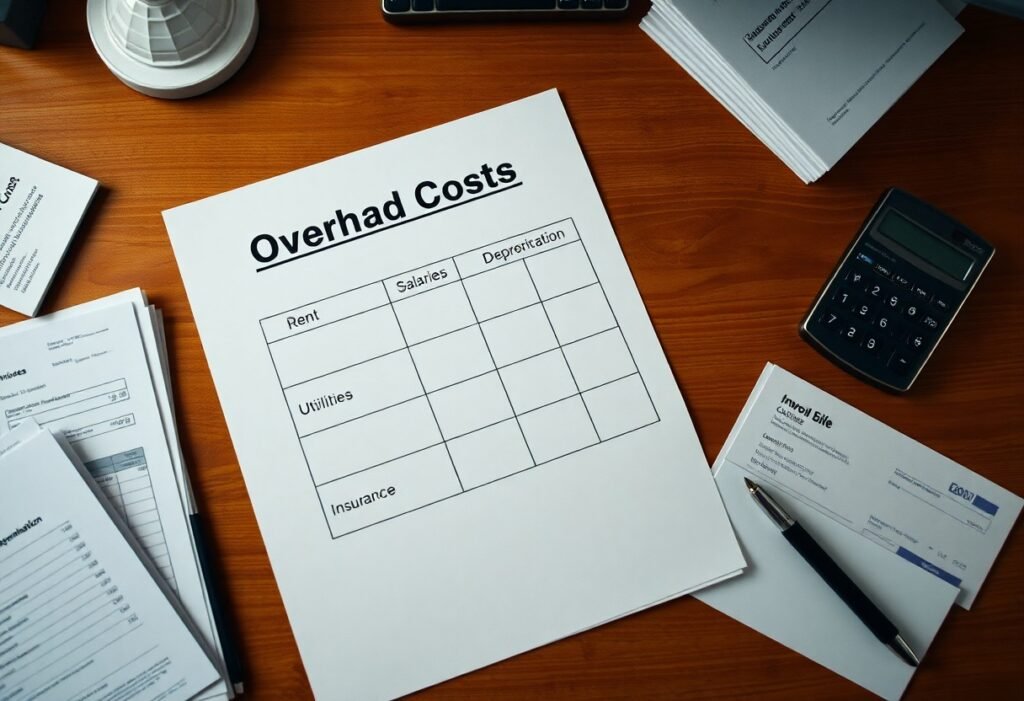
You should understand overhead costs as the ongoing expenses that keep your business running-rent, utilities, insurance, administrative salaries and other expenditures not tied to producing a specific product or service; knowing these costs helps you set prices, control spending, allocate resources and improve profitability by separating fixed and variable overhead accurately.
Key Takeaways:
- Overhead costs are ongoing indirect expenses not tied to producing a specific product or service (rent, utilities, office admin).
- They split into fixed overhead (rent, insurance) and variable overhead (utilities, indirect labor) with different planning impacts.
- Allocate overhead to products or projects using methods like square footage, labor hours, or machine hours to find true unit cost.
- Overhead influences pricing, profit margins, and cash flow; underestimating it can cause underpriced offerings and losses.
- Manage overhead by tracking expenses, cutting waste, negotiating contracts, automating tasks, or outsourcing to spread fixed costs.
Definition of Overhead Costs
In practice, overhead costs are the non-production expenses that keep your business running – rent, utilities, salaried admin, insurance, and depreciation. They recur monthly or annually and don’t vary directly with units produced; for example, rent might be $5,000/month while production doubles. You track them to set prices, control margins, and forecast cash flow.
Direct vs. Indirect Costs
Direct costs tie directly to a product or job-raw materials ($10/unit) and direct labor (2 hours at $20/hr). Indirect costs cannot be traced to a single unit and become overhead-utilities, janitorial, and supervisor salaries. You allocate indirect costs using drivers like machine hours; manufacturers commonly see overhead at 15-30% of production cost, which affects unit pricing and margin calculations.
Types of Overhead Costs
Fixed overhead stays constant regardless of output (rent $5,000/month); variable overhead rises with activity (electricity $0.05/kWh); semi-variable combines both (phone plan with base fee plus per-minute charges). Administrative and selling overheads (marketing budgets, office staff) also fall under this category, so you monitor each type to understand cost behavior and pricing levers.
- Rent and property expenses
- Utilities and energy costs
- Office administration and salaries
- Insurance and licenses
- Thou should allocate overheads to products using a consistent method
| Rent | $5,000/mo fixed – large predictable cash outflow |
| Utilities | $1,200/mo variable – rises with production hours |
| Admin Salaries | $8,000/mo fixed – covers HR, finance, execs |
| Insurance | $600/mo annualized premium – periodic expense |
| Depreciation | $1,000/mo non-cash – affects taxable profit |
To allocate types effectively, convert totals into per-unit rates: if monthly overhead is $15,800 and you produce 10,000 units, overhead equals $1.58/unit. You can lower that rate by increasing output, outsourcing non-core tasks, shifting fixed fees to variable contracts, or investing in energy efficiency; each tactic changes cost structure and break-even points.
- Audit recurring subscriptions and cancel unused services
- Negotiate bulk energy rates or implement LED upgrades
- Outsource routine tasks like payroll to reduce headcount
- Use activity-based costing to more accurately price products
- Thou must monitor monthly overhead KPIs to spot deviations early
| Machine hours | Overhead ÷ total machine hours – $/machine-hour allocation |
| Direct labor hours | Overhead ÷ total labor hours – $/labor-hour allocation |
| Square footage | Facility costs ÷ occupied sqft – for rent/maintenance |
| Units produced | Overhead ÷ units produced – simple per-unit rate |
| Activity-based drivers | Assign costs by activities (setups, inspections) for accuracy |
Importance of Understanding Overhead Costs
When you track overhead closely, you can spot inefficiencies-like a 20% spike in utilities or underused office space-before they erode margins. Knowing fixed versus variable overhead helps you forecast cash flow and set targets; for deeper reading see Overhead Expenses Explained. Accurate overhead allocation also supports tax planning and investor reporting, so you can justify staffing levels, negotiate leases, or identify cost-saving investments that raise your operating leverage.
Budgeting and Financial Planning
You should allocate overhead as a percentage of revenue-many service firms target 20-35%-and update forecasts monthly to capture seasonality. Use line-item budgets for rent, utilities, insurance, and IT; for example, reducing office utility bills by 10% can improve net margin by 1-2 points on tight 5-10% margins. Scenario plans (best/worst case) help you plan hiring or capex without jeopardising cash runway.
Pricing Strategies
In pricing, include overhead to avoid margin leakage: calculate overhead per unit-for instance, $100,000 overhead divided by 10,000 units equals $10 each-and build that into your cost base. Retailers often apply 2-3x markup, while professional services load hourly rates with 25-50% overhead multipliers. Doing this keeps your gross margin targets realistic and prevents underpricing during growth.
To put it into practice, compare absorption costing and activity-based costing (ABC): ABC assigns overhead based on drivers (machine hours, transactions) and can shift per-unit overhead by 10-40% for mixed-product lines. If a product has $30 direct cost and $10 allocated overhead and you want a 20% net margin, price = (30+10)/(1-0.20) = $50; if ABC shows overhead is actually $14, your price should rise to $56 to hit the same margin.
Common Examples of Overhead Costs
You’ll encounter overhead in many forms: rent, utilities, office admin, insurance, depreciation, and maintenance. For example, a small retail shop might pay $3,500/month rent, $400/month utilities, and $600/month for insurance and taxes, totaling roughly $4,500-$5,000 of monthly overhead. These items keep your operations running even when sales ebb, so tracking each category helps you spot where cuts or efficiencies will actually affect your bottom line.
Fixed Overhead Costs
Fixed overhead stays constant regardless of output: think rent, salaried staff, insurance premiums, property taxes, and straight-line depreciation. If your lease is $5,000/month, that cost persists whether you produce 0 or 10,000 units. You should annualize fixed costs for budgeting-$5,000×12 = $60,000/year-and allocate them per unit during costing to see true profitability as volume changes.
Variable Overhead Costs
Variable overhead rises and falls with activity levels, including utilities tied to machine use, indirect materials, production-related maintenance, and waste disposal. For instance, factory electricity might jump from $600 to $2,400/month as you ramp production, reflecting a direct link to throughput. Monitoring these costs per unit helps you forecast margins as you scale.
To manage variable overhead you should measure cost per unit: divide the monthly variable overhead by units produced. If electricity and maintenance total $1,800 one month and you produce 30,000 units, that’s $0.06/unit. Case studies show manufacturers who lowered variable overhead by 10-20% through energy-efficient motors and preventive maintenance improved gross margins materially, so target specific drivers like run-time, waste rates, and batch sizing.
How to Calculate Overhead Costs
Gather total indirect expenses for the period (rent, utilities, depreciation, admin), choose an allocation base, then compute an overhead rate: Overhead Rate = Total Overhead ÷ Allocation Base. For example, if your monthly overhead is $12,000 and you logged 2,400 direct labor hours, your rate is $5 per labor hour; apply that rate to products using labor hours to assign overhead. Track the same period and base consistently to compare margins month-to-month.
Allocation Methods
Common allocation bases are direct labor hours, machine hours, square footage, or sales value; manufacturers often use machine hours, while firms offering billable services use labor hours. For instance, allocating $20,000 monthly overhead by 4,000 machine hours yields $5 per machine hour. You can also allocate by percent of sales (useful for retail) or by floor space for facilities-heavy operations; the choice should reflect the driver that best correlates with incurring those indirect costs.
Activity-Based Costing
ABC assigns overhead to specific activities (setups, inspections, material handling) using measurable drivers, giving you more accurate product costs. For example, if setups cost $30,000 annually and product A uses 150 of 600 setups, A is charged 25% = $7,500. ABC works best when products consume overhead differently and when you can track driver counts reliably.
To implement ABC, identify activities (often 10-50), assign overhead pools, select drivers, gather driver volumes, compute activity rates, then apply rates to products. A typical mid-sized pilot tracking 8-12 drivers may take 2-3 months to set up; you might discover product-level overhead shifts of 15-40% versus traditional allocation, prompting repricing or SKU rationalization. Expect higher setup effort and data collection, but clearer visibility for process improvements and strategic decisions.
Reducing Overhead Costs
You can cut overhead by targeting specific line items: renegotiate vendor contracts to shave 5-15% off recurring fees, audit and cancel unused subscriptions (many companies drop 8-12% of SaaS spend), and sublease idle space to convert fixed rent into variable income; for energy, simple measures like LED retrofits and programmable thermostats often lower utility bills by 15-30% within a year.
Efficiency Improvements
You should map bottlenecks and apply lean fixes: automating invoice approvals can reduce AP processing time by up to 60%, cross-training staff lowers overtime and temp hiring by 10-25%, and scheduled preventive maintenance reduces equipment downtime and repair costs – manufacturers often report a 7-12% drop in maintenance-related overhead after standardizing procedures.
Technology Utilization
You can leverage tech to slash indirect costs: moving servers to cloud platforms converts capex to opex and, with autoscaling, can cut hosting bills 20-40% for variable workloads; adopting SaaS for HR, payroll, and CRM typically reduces IT maintenance overhead and speeds deployment, while energy-efficient equipment (LEDs, smart thermostats) lowers utility spend substantially.
When evaluating tech investments, run a simple ROI: estimate upfront cost, annual savings, and payback period – LED retrofits often pay back in 1-3 years, while cloud migrations may break even in 6-18 months depending on scale. You should also factor integration, staff training, and security: budget 10-20% of project cost for implementation and plan phased rollouts to protect operations during transition.
Overhead Costs in Different Industries
Across sectors, your overhead profile depends on capital intensity and staffing models: manufacturing leans on equipment, utilities and maintenance while services load up on rent, software and admin. Typical manufacturing overhead ranges from about 15-35% of product costs, whereas service firms often measure overhead per billable hour to set rates and monitor margins.
Manufacturing
In manufacturing, your overhead covers factory rent, machine depreciation, quality control, indirect labor and maintenance. You usually allocate costs by machine hours or units produced; for example, $150,000 of indirect costs spread over 30,000 machine hours yields an overhead rate of $5 per machine hour, which you then add into unit cost calculations.
Service-based Businesses
For service firms, your overhead is heavier on office rent, CRM/subscription software, training and administrative salaries. You often convert annual overhead into a per‑hour figure: if your firm has $120,000 yearly overhead and bills 2,400 collective hours, that’s $50 of overhead per billable hour to include in pricing.
Digging deeper, you should track utilization because it directly changes overhead per hour: with $100,000 overhead and 2,000 potential hours, 75% utilization (1,500 billed hours) equals $66.67 overhead/hour, while 60% (1,200 hours) equals $83.33/hour – a 25% rise that forces higher rates or cost cuts to maintain margins.
Final Words
Following this, you can see that overhead costs are the ongoing non-production expenses-rent, utilities, insurance, and administrative salaries-that keep your business operating. Managing and categorizing these costs helps you set prices, control margins, and plan cash flow, so you make informed decisions about efficiency and profitability.
FAQ
Q: What are overhead costs?
A: Overhead costs are ongoing business expenses that cannot be directly traced to a specific product or service, such as rent, utilities, insurance, and administrative salaries. They support operations but are not part of the direct materials or direct labor used to make a product.
Q: What types of overhead costs exist?
A: Overhead is commonly grouped into fixed (rent, insurance), variable (utilities that rise with activity), and semi-variable or mixed costs (salaries plus overtime, phone plans with base fees plus usage). Classification helps with budgeting and forecasting.
Q: How do I calculate my overhead rate?
A: A basic overhead rate = (Total overhead costs ÷ Total direct labor or direct production costs) × 100. For example, if overhead is $50,000 and direct labor is $200,000, the overhead rate is 25%, which can be used to allocate overhead to products or jobs.
Q: How do overhead costs affect pricing and profit?
A: Overhead raises the total cost of producing goods or services; if not allocated into price, profit margins shrink. Properly estimating and adding a fair share of overhead to product prices ensures costs are covered and target profits are achievable.
Q: What practical steps can a business take to lower overhead costs?
A: Audit recurring expenses and cut unused subscriptions, negotiate leases and supplier contracts, improve energy efficiency, outsource noncore functions, automate repetitive tasks, and consider remote or hybrid work to reduce facility needs. Track savings and reinvest efficiencies into growth or margin improvement.